


Cotton vs linen decorative trims is, at its core, a sourcing decision rather than a styling one. Cotton is the lower-cost, high-consistency fiber: it dyes uniformly, reorders match reliably across dye lots, and it scales smoothly into large wholesale programs – making it the default for tassels, macrame, fringes, cords and seasonal ornaments. Linen, spun from flax, offers notably higher tensile strength, a natural slub texture and strong sustainability credentials, which supports premium and luxury retail positioning – ideal for curtain tiebacks, statement fringes and heritage-styled collections. Cotton carries a lower landed cost per unit; linen costs more but recovers that cost at retail through higher price points. Our recommendation as a manufacturer: match the fiber to your retail positioning and product function, not just the unit price – and always evaluate dyed physical samples before committing to bulk production.
Quick Answer: Cotton or Linen – Which Is Better for Decorative Trims?
Quick answer: Cotton is the better fiber for most wholesale trim programs because it costs less, dyes uniformly, and color-matches reliably on reorders. Linen is the better fiber when load-bearing strength, luxury positioning, or a sustainability story justifies a higher unit cost. Most established import programs carry both: cotton for core volume lines, linen for premium capsule collections.
At a glance:
| Buying priority | Recommended choice |
|---|---|
| Best overall for wholesale | Cotton (COT) – cost, consistency, scalability |
| Best budget option | Staple Cotton (SCT) – lowest cost per kg |
| Best luxury option | Linen Chainette (LCH) – premium hand-feel with a full silhouette |
| Best for hospitality | Cotton for volume properties; linen for boutique hotels |
| Best for sustainability positioning | Linen – low-input, largely rain-fed flax |
| Best for reorders & color matching | Cotton – highest dye-lot consistency |
What Are Decorative Trim Fibers?
Definition: Decorative trim fibers are the yarns from which tassels, curtain tiebacks, fringes, cords, macrame and other home furnishing accessories are constructed. The fiber determines a trim’s cost, strength, dye behavior, texture, durability in use and performance during export transit – which is why fiber selection is the first decision in any wholesale trim sourcing program.
Cotton Fiber
Cotton is a seed fiber harvested from the cotton plant, spun into soft, matte yarns with relatively short staple lengths. It absorbs dye readily and evenly, which is why cotton dominates color-critical, high-volume trim production. India is among the world’s largest cotton producers, so for a Delhi-based manufacturer like Mohit Handicrafts, cotton yarn is a domestic input – a supply-chain advantage that translates into shorter procurement lead times and steadier pricing for buyers.
Linen Fiber
Linen is a bast fiber extracted from the stem of the flax plant. Its fibers are long and exceptionally strong, producing yarn with a subtle natural sheen and characteristic slub texture. The majority of high-grade flax is cultivated in Western Europe – principally France, Belgium and the Netherlands – and Indian trim production typically works with imported flax-based yarns. That import step is part of why linen trims cost more and need slightly longer planning horizons than cotton programs.
Why Fiber Selection Matters in Wholesale Sourcing
The fiber you specify flows through every downstream cost and quality outcome: unit price, dye-lot consistency across reorders, tensile performance in load-bearing products such as tiebacks, behavior in humid container transit, the retail price point your end customer will accept, and how easily your line can be replenished six months from now. Choosing fiber by retail strategy – rather than by lowest quoted price – is the single most reliable way to avoid sourcing regret.
Cotton Decorative Trims Explained
In short: Cotton is the workhorse fiber of wholesale decorative trims – the most cost-effective, most color-consistent and most scalable choice for bulk orders, standing retail lines and private label programs.
How Cotton Trims Are Manufactured
Cotton yarn is spun, dyed (with highly uniform dye uptake), and then converted by hand and machine into finished trims: twisted into cords and ropes, knotted into macrame, chain-knit into chainette for full-bodied tassels, or cut and looped into fringes. At Mohit Handicrafts, every cotton order begins with dye-lot testing before bulk production, so the approved color standard holds across the full order quantity.
Cotton Yarn Types We Manufacture With
As a cotton decorative trims manufacturer, we work with three principal cotton variants from our fiber catalogue:
- Cotton (COT): Standard spun cotton yarn. Predictable dye uptake across large lots – critical when a buyer needs color-matched trims across a multi-thousand-unit order.
- Staple Cotton (SCT): Shorter-fiber cotton with a slightly coarser hand-feel. Lower cost per kilogram, well suited to high-volume programs where price point outranks texture.
- Cotton Chainette (CCH): Hollow-core, chain-knit cotton construction. Slightly higher production cost, but it delivers the full, bouncy silhouette that lets cotton chainette tassels sell at stronger retail price points.
Common Applications
Tassels, budget and mid-market curtain tiebacks, brush fringes, decorative braids and gimp, macrame cords and finished macrame products, coasters, tufts, and Christmas ornaments.
Advantages of Cotton Decorative Trims
- Dye-lot consistency: Cotton absorbs dye uniformly, so a 5,000-piece order placed today will match a 5,000-piece reorder placed six months from now – the decisive factor for standing retail lines.
- Lower cost per kg: The most economical natural fiber trim input at every volume tier.
- Fine-gauge precision: Easier to produce at fine gauges and tight tolerances, making it the default for delicate fringe work.
- Domestic supply chain: Locally sourced yarn in India means shorter lead times and more flexible minimum order quantities.
- Saturated colorways: Takes bright, deep, seasonal colors evenly – essential for holiday and fashion-led collections.
Limitations of Cotton
- Lower tensile strength than linen, which matters in daily load-bearing products such as heavy-drapery tiebacks.
- Reads as mass-to-mid-market in luxury retail segments where buyers expect visible natural texture.
- Absorbs ambient moisture, so humid-transit shipments should be poly-lined and packed with desiccants.
Cost Implications
Cotton delivers the lowest per-unit cost at volume. Staple cotton is the most economical entry point; cotton chainette carries a modest premium that typically pays back through higher perceived retail value.
Export Suitability
Suitable for all export markets, including price-sensitive ones. Cotton is the backbone of most private label textile trims programs precisely because it behaves predictably at scale.
Linen Decorative Trims Explained
In short: Linen is the premium-positioning fiber – stronger than cotton, naturally textured, and backed by a genuine sustainability story – best deployed where a higher unit cost is recoverable through a higher retail price.
Flax Sourcing
Linen begins as flax, and the world’s finest flax is concentrated in Western Europe’s coastal growing belt across France, Belgium and the Netherlands. Because Indian manufacturers generally source flax-based yarn through import channels, linen trim pricing tracks flax harvests and currency movement more closely than cotton does – a point importers should factor into annual buying plans.
How Linen Trims Are Manufactured
Flax fiber is retted, scutched and spun into linen yarn by specialist yarn producers; we then dye and convert it into finished trims. Linen’s natural wax and pectin content means dye uptake is slightly less uniform than cotton’s, producing the tonal, lived-in color depth that premium buyers actively seek – but which requires agreed dye-lot tolerances in wholesale contracts. Our linen catalogue centers on two constructions:
- Linen (LIN): Raw linen yarn with natural slub texture. Every batch carries slight, organic variation – buyers should set quality tolerance expectations with their own retail customers accordingly.
- Linen Chainette (LCH): A refined, chain-knit linen construction that retains linen’s strength and subtle sheen while delivering a fuller silhouette – the linen chainette tassel is the closest premium counterpart to cotton chainette.
Premium Positioning
Linen’s slub texture reads as artisanal and authentic at retail, and the “European flax” narrative is a proven premium signal in US, UK and EU home decor markets. For brands building a luxury home furnishing accessories range, linen is the fiber that visually justifies the price tag.
Sustainability Benefits
Flax is a low-input crop: in its main European growing regions it is largely rain-fed, requires comparatively few pesticides, and nearly the whole plant is used across industries. Untreated linen is fully biodegradable, which makes linen trims a strong fit for sustainable home decor materials programs and eco-labelled retail lines.
Limitations of Linen
- Higher raw material cost and import-linked lead times.
- Natural batch variation requires wider reorder color tolerances than cotton.
- Low elasticity – a minor factor in trims, though it contributes to linen’s characteristic crisp, structured drape.
Export Suitability
Strongest in the US, UK, EU and Australian premium and sustainability-led segments, and in boutique hospitality projects where texture and provenance carry weight with the end client.
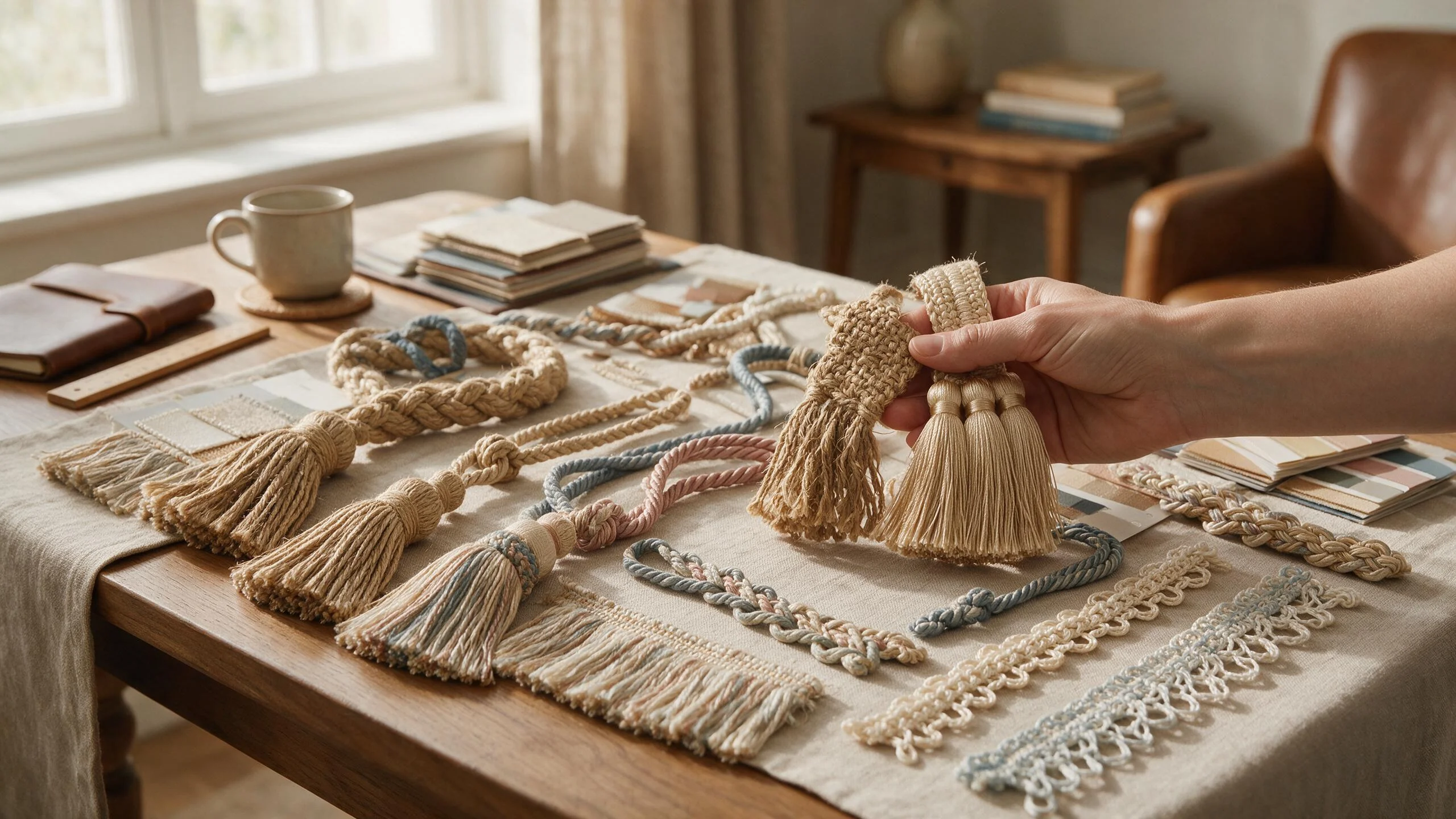
Cotton vs Linen: Full Sourcing Comparison Table
| Factor | Cotton | Linen |
|---|---|---|
| Relative cost per kg | Lower – most economical natural fiber input | Higher – premium yarn, often import-linked |
| Tensile strength | Good | Very high – among the strongest natural plant fibers |
| Durability in use | Good; suited to normal handling and display | Excellent; withstands daily load and abrasion |
| Dye-lot consistency | High – uniform uptake, reliable matching | Moderate – natural tonal variation between lots |
| Sustainability profile | Good; strongest with organic or better-cotton programs | Excellent; low-input, largely rain-fed flax |
| MOQ flexibility | Highest – domestic yarn supply supports pilot runs | Moderate – yarn procurement favors consolidated orders |
| Lead times | Shorter – locally sourced yarn | Longer – build in buffer for flax yarn supply |
| Bulk production suitability | Excellent at every volume tier | Good, at premium price points |
| Private labeling | Excellent for core volume lines | Excellent for premium capsule lines |
| Luxury perception | Mass to mid-premium | Premium to luxury |
| Maintenance | Easy – spot clean or gentle wash | Easy – spot clean; softens with age, may crease |
| Export / transit performance | Stable; protect from container humidity | Very stable; dries quickly, handles humidity well |
| Hospitality suitability | Volume properties – durable, economically replaceable | Boutique and five-star properties – texture and prestige |
| Furniture industry suitability | Standard for tufts, gimp and volume fringe | Best for load-bearing tiebacks and statement fringe |
Cotton vs Linen by Product Type
In short: Match fiber to product function first, aesthetics second. Load-bearing and luxury products favor linen; volume, color-critical and fine-gauge products favor cotton.
Curtain Tiebacks
- Best fiber: Linen for structural performance; cotton for price-sensitive lines.
- Why: Tiebacks and holdbacks bear the daily weight of drapery, and linen’s superior tensile strength directly extends product life.
- Cost implication: Linen tiebacks command a meaningfully higher wholesale and retail price; cotton keeps entry-level curtain accessory ranges competitive.
- Market fit: Linen for premium drapery retailers and interior design trade programs; cotton for mass-market wholesale curtain accessories.
Tassels
- Best fiber: Cotton chainette as the standard; linen chainette for boho-luxury positioning.
- Why: Chainette construction gives tassels their full, bouncy skirt – cotton achieves this at a competitive cost, while linen adds premium hand-feel and sheen.
- Cost implication: Cotton chainette tassels hit mid-market price points; linen chainette supports luxury pricing.
- Market fit: Cotton for volume retail and export programs; linen for designer and heritage collections.
Bullion Fringes
- Best fiber: Cotton for consistent twist and weight at volume; linen for statement upholstery.
- Why: Bullion’s heavy twisted-loop construction demands yarn consistency across long runs – cotton delivers it economically, while linen bullion creates a distinctive heritage look for high-end furniture.
- Cost implication: Linen bullion is a premium line item best reserved for furniture priced to absorb it.
- Market fit: Cotton for upholstery manufacturers at scale; linen for restoration, heritage and luxury furniture brands.
Brush Fringes
- Best fiber: Cotton.
- Why: Brush fringe requires fine, dense cut-pile at tight tolerances – cotton’s fine-gauge workability makes it the natural default; linen suits chunkier, texture-forward brush styles.
- Cost implication: Cotton keeps per-meter costs low across long trim runs.
- Market fit: Cotton for cushion, drapery and lampshade trim programs; linen for artisan-styled decor lines.
Decorative Trims, Braids & Gimp
- Best fiber: Cotton as default; linen for chunky artisan trims.
- Why: Precision braiding favors cotton’s uniform diameter; linen’s slub creates intentional texture in wider, rustic trims.
- Cost implication: Cotton minimizes wastage on tight-tolerance braiding runs.
- Market fit: Cotton for furniture and apparel trim supply; linen for craft-luxury home decor.
Decorative Cords & Lip Cords
- Best fiber: Cotton for cost and consistency; linen for rustic or heritage lines.
- Why: Cotton cord is the most economical, dimensionally consistent option for bulk trim and piping programs; linen cord adds visible natural character.
- Cost implication: Cotton cord keeps upholstery piping and macrame cord programs at competitive landed costs.
- Market fit: Cotton for furniture, drapery workrooms and craft wholesale; linen for premium and heritage-positioned catalogues.
Macrame Products
- Best fiber: Cotton.
- Why: Cotton is the industry-standard macrame fiber – easy to knot, consistent in thickness across long production runs, and available in every colorway. Linen is used selectively for premium macrame wall-hanging lines.
- Cost implication: Cotton keeps macrame home decor accessible at retail; linen roughly doubles the perceived value tier.
- Market fit: Cotton for volume macrame wholesale; linen for gallery-style and boutique decor.
Coasters
- Best fiber: Cotton for function; linen for tabletop luxury.
- Why: Cotton’s absorbency and easy cleaning make it the practical fiber for working coasters; linen suits gift-boxed, premium tabletop ranges.
- Cost implication: Cotton coasters support hospitality and promotional pricing; linen supports giftware margins.
- Market fit: Cotton for restaurants, cafes and volume retail; linen for premium homeware brands.
Christmas Ornaments
- Best fiber: Cotton chainette for saturated seasonal color; linen for natural, Scandinavian-style collections.
- Why: Holiday programs live and die by color – cotton delivers bright, consistent festive palettes at volume, while linen’s neutral, tactile look serves the rising demand for natural-fiber holiday decor in export markets.
- Cost implication: Cotton maximizes margin on volume seasonal buys; linen justifies premium price points in curated holiday ranges.
- Market fit: Cotton for mass seasonal retail; linen for design-led and sustainable holiday collections.
Upholstery Accessories: Tufts & Holdbacks
- Best fiber: Cotton for tufts; linen for premium holdbacks.
- Why: Upholstery tufts are produced in high counts where cotton’s consistency and cost rule; holdbacks share tiebacks’ load-bearing demands, where linen’s strength earns its premium.
- Cost implication: Cotton tufts keep furniture BOM costs tight; linen holdbacks position drapery hardware ranges upmarket.
- Market fit: Cotton for furniture manufacturers; linen for premium drapery and interior design supply.
Blended and Alternative Natural Fibers Worth Considering
In short: If neither pure cotton nor pure linen fits your program, blends and alternative fibers can bridge cost, texture and positioning gaps.
- Cotton–linen blends: Deliver linen’s visible texture closer to cotton’s price and dye behavior – a practical middle path for mid-premium ranges.
- Jute (JUT): The rustic, high-texture fiber for farmhouse and natural-decor trims at economical cost.
- Hemp (HMP): Strong and eco-positioned; suits sustainability-led cord and trim lines.
- Bamboo Fiber (BMB): Soft hand-feel with an eco narrative for contemporary decor programs.
- Viscose (VIS) & Rayon Silk Chainette (RS): High-sheen fibers often specified alongside cotton for lustrous, jewel-toned tassels – particularly in Middle East and formal-decor markets.
- Metallic Zari (MZ): Traditional Indian metallic accent yarn, typically combined with cotton or viscose bodies for festive and luxury trims.
Buyers building a multi-tier catalogue often anchor volume lines in cotton, position a premium tier in linen, and use blends or accent fibers to differentiate seasonal capsules.
Country-Specific Buying Guide
In short: Cotton sells everywhere; linen over-indexes in markets where natural texture and sustainability drive purchase decisions – the US, UK, EU and Australia – while sheen and saturated color lead in the Middle East.
United States
The US home decor import market spans every tier, from big-box volume to designer trade. Cotton dominates volume programs and ecommerce lines where reorder color-matching is non-negotiable; linen over-indexes in coastal, farmhouse and organic-modern aesthetics that dominate premium retail. Sustainability labelling is an accelerating purchase driver. A practical program structure for US importers: cotton core range plus a linen premium capsule.
United Kingdom
UK buyers respond strongly to heritage and country-house aesthetics, where linen tiebacks, bullion fringes and natural-toned trims feel native. Natural-fiber and provenance messaging performs well at retail. Mid-market and high-street programs still run on cotton for cost and consistency, but linen earns disproportionate shelf space in premium UK drapery and interiors retail.
Europe (EU)
EU markets carry the highest sustainability expectations, and flax’s European growing heritage makes linen an easy story to tell. Scandinavian-influenced retail favors linen and undyed, neutral palettes; Southern European markets lean warmer and more color-saturated, where cotton’s dye range excels. EU buyers frequently request substance-compliance documentation for dyed goods – raise this at enquiry stage so dye sourcing can be aligned.
Australia
Coastal and Hamptons-style interiors have made linen a mainstream preference in Australian decor retail. The practical constraint is freight distance: consolidate orders, plan reorder cycles early, and specify humidity-appropriate packaging for the long sea leg. Cotton remains the base for volume and seasonal programs.
Middle East
Gulf-market decor favors opulence: saturated jewel tones, gold accents and visible sheen. Cotton provides the reliable dyed base, frequently paired with viscose, rayon-silk chainette and metallic zari accents to achieve the luster the market expects. Large hospitality and residential projects in the region typically demand custom color development and firm delivery schedules.
Luxury Hospitality Sector
Hotel and resort projects buy on durability, replaceability, custom color matching to brand palettes, and deadline reliability. Large chains and volume refurbishments favor cotton programs with attic stock held for future room cycles; boutique and five-star properties specify linen for its texture and prestige in guest-facing drapery and soft furnishing details.
Wholesale Sourcing Considerations
In short: The fiber decision is only step one – MOQ structure, dye-lot management, packaging and reorder planning determine whether a trim program stays profitable after the first shipment.
MOQ Planning
Pilot new lines at accessible minimums, then scale into full production once sell-through proves out. Cotton’s domestic yarn supply supports the most flexible MOQs; linen programs are more efficient when colors and quantities are consolidated per order.
Lead Times
Production lead times vary with order volume, customization depth and season. As a rule, build additional buffer into linen programs (import-linked yarn supply) and book production slots early for Q4-bound seasonal goods. Confirm current lead times at quotation.
Color Consistency
Approve lab dips or dyed physical standards before bulk. Define acceptable tolerance in writing – tight for cotton, wider for linen, where tonal variation is inherent to the fiber.
Dye-Lot Management
Specify single-dye-lot production per purchase order wherever possible, and retain sealed reference samples on both sides. Cotton reorders match reliably against retained standards; linen reorders should be assessed against the agreed tolerance window rather than expecting identical lots.
Inventory Planning
Carry safety stock on hero SKUs with proven reorder velocity. For linen lines, ordering larger quantities less frequently reduces cumulative lot-to-lot variation on the retail shelf.
Container Optimization
Trims are light but voluminous, so per-unit freight is driven by carton dimensions more than weight. Mixed-SKU consolidation, compression-conscious packing and full-container planning materially reduce landed cost – and watch volumetric weight if any portion ships by air.
Packaging Requirements
Specify poly-lined cartons with desiccants for humid sea transit – cotton in particular should travel dry. Choose the packing format that matches your channel: bulk hanks for workrooms, carded or bagged units for retail, or fully retail-ready packs with your barcoding and labelling.
Private Label Manufacturing
Private label textile trims programs – custom labels, hangtags, retail packaging and catalogue support – let importers and brands sell manufacturer-direct quality under their own name. Both cotton and linen lines can be fully private-labelled.
OEM Production
For buyers with proprietary designs, OEM decorative trims manufacturing follows a disciplined path: specification, sampling, sealed-sample approval, then bulk – with market-exclusivity arrangements available by agreement.
Landed Cost & Import Basics for Decorative Trims
In short: Compare fibers on landed cost – not FOB price – because freight, duty and compliance apply to both and can narrow or widen the cotton–linen gap by market.
Decorative trims such as braids, ornamental trimmings, tassels and pompons are generally classified under HS heading 5808, though final classification and duty rates vary by destination – always confirm with your customs broker. Landed cost builds up as: unit FOB price + freight and insurance + import duty and taxes + local handling. Because trims are volumetric cargo, consolidation strategy often moves landed cost more than fiber choice does. We support buyers with complete export documentation to keep customs clearance predictable.
Seasonal Production & Order Timing
In short: Seasonal trim programs are won or lost on the calendar – sample early, confirm bulk before peak production season, and reserve reorder capacity mid-season.
- Christmas ornaments and holiday trims: Sample and finalize designs in Q1, confirm bulk orders by late Q2 to comfortably hit Q4 retail shelves after production and sea transit.
- Spring/summer decor resets: Confirm orders the preceding autumn.
- Standing retail lines: Schedule reorders against sell-through data rather than stockouts, so dye-lot production can be planned rather than rushed.
- Linen programs: Add procurement buffer at every stage, since flax yarn supply is import-linked.
Common Mistakes Buyers Make
- Choosing solely by price: The cheapest fiber that fails in use – a snapped budget tieback under heavy drapery – costs more in returns and reputation than the linen upgrade would have.
- Ignoring dye-lot variation: Especially on linen, assuming reorder lots will match perfectly leads to shelf-level color mismatch. Agree tolerances upfront.
- Underestimating freight costs: Trims ship by volume, not weight. Quoting programs on FOB price alone routinely understates true landed cost.
- Not testing physical samples: Photographs cannot convey hand-feel, skirt fullness, twist quality or true color. Always evaluate dyed samples before bulk.
- Wrong fiber for the product category: Cotton in heavy load-bearing tiebacks, or linen in color-critical saturated seasonal lines, are both avoidable mis-specifications.
- Poor reorder planning: Placing urgent reorders without dye-lot lead time forces rushed matching – the root cause of most consistency complaints.
- Skipping humidity-appropriate packaging: Unlined cartons on long sea legs invite moisture issues that no fiber choice can fix.
- Leaving compliance to the last minute: Regulated markets may require dye and substance documentation; raise requirements at enquiry, not at shipment.
Buyer’s Sample Evaluation Checklist
Use this checklist when fiber samples arrive – it converts a subjective look-and-feel review into a sourcing-grade evaluation:
- Confirm fiber content and yarn construction against the quotation (e.g., COT vs CCH, LIN vs LCH).
- Tug-test load-bearing points – tieback loops, cord cores, tassel necks.
- Rub-test dyed surfaces for color transfer onto white cloth.
- Compare color under daylight and warm interior lighting, against your approved standard.
- For linen: review slub character and agree what natural variation is acceptable.
- Measure against specification – lengths, diameters, skirt fullness, loop drop.
- Check knot security and finishing on tassel heads and fringe headers.
- For coasters and functional items: spot-clean test.
- Photograph and seal an approved reference sample – one retained by you, one by the manufacturer.
- Confirm packaging format and labelling on the sample dispatch itself.
Expert Recommendation Matrix
| Buyer Type | Recommended Fiber | Reason |
|---|---|---|
| Importers / Wholesalers | Cotton core + linen capsule | Cotton scales and reorders reliably; linen lifts catalogue positioning |
| Interior Designers | Linen (custom-colored) | Texture, strength and bespoke color for trade projects |
| Hotels & Hospitality | Cotton (volume) / Linen (boutique) | Replaceability and budget vs texture and prestige |
| Retail Chains | Cotton | Dye-lot consistency across stores and reorder cycles |
| Furniture Brands | Cotton tufts & gimp; linen statement fringe | Cost control on volume components, premium accents where visible |
| Luxury Brands | Linen / Linen Chainette | Natural texture and provenance justify luxury price points |
| Ecommerce Brands | Cotton, with linen premium SKUs | Photo-consistent color across batches; linen for AOV growth |
Sustainability Comparison: Cotton vs Linen
In short: Both are natural, biodegradable fibers – but flax’s low-input agronomy gives linen the stronger headline sustainability story, while cotton programs can close the gap through organic and better-cotton sourcing.
- Carbon impact: Both are plant-based fibers with fundamentally lower lifecycle impact than synthetics; flax cultivation is comparatively low-intervention.
- Water usage: Conventional cotton is an irrigation-heavy crop in many regions; European flax is predominantly rain-fed.
- Biodegradability: Untreated cotton and linen trims are both fully biodegradable.
- Renewable sourcing: Both are annual crops; flax adds efficiency because nearly the entire plant is utilized.
- Circular-economy suitability: Mono-fiber natural trims (all-cotton or all-linen, without synthetic cores) are the most compost- and recycling-friendly construction – a specification detail worth requesting for eco-labelled lines.
Buyers with certification or eco-labelling requirements should state them at enquiry stage so yarn sourcing and documentation can be aligned from the outset.
Why Manufacturers Often Recommend Cotton
The honest answer: cotton produces fewer surprises – for the buyer as much as the factory. Its dye behavior is predictable, its domestic supply keeps quotations stable, its fine-gauge workability holds tolerances across long runs, and its reorders match. For a first-time import program, a multi-door retail rollout, or any line where color continuity is contractual, cotton is the lower-risk recommendation. That is process logic, not a margin play – and it is also why an experienced manufacturer will steer you away from cotton when the product is a load-bearing luxury tieback or a sustainability-flagship line where linen is simply the correct engineering and positioning choice.
When Linen Becomes the Better Investment
Real sourcing scenarios where linen’s premium pays back:
- A premium decor brand with strong retail multiples: When retail pricing runs at healthy multiples of landed cost, linen’s extra fiber cost becomes a rounding error against the price-point uplift it enables.
- Boutique hospitality refurbishment: Fewer rooms, higher spec, longer replacement cycles – linen’s durability and texture outperform over the asset’s life.
- Sustainability-led EU or US retail: Where natural-fiber and low-input sourcing claims drive conversion, linen is the fiber that substantiates the story.
- Heritage and tactile categories: Bullion fringe, chunky macrame wall pieces and holdbacks visibly reward linen’s character.
- Differentiation in a crowded market: When competitors all carry cotton lookalikes, a linen tier creates a defensible premium shelf.
Care & Maintenance Guidance (Retailer-Ready)
Adapt this copy directly for your product pages and care labels:
- Cotton trims: Spot clean with mild detergent and cool water; hand wash gently if fully soiled. Air dry flat – never wring tassels. Avoid chlorine bleach.
- Linen trims: Spot clean; linen softens gracefully with age. Light steaming relaxes creases. Avoid chlorine bleach.
- Both fibers: Keep out of prolonged direct sunlight to preserve dye depth, and store dry between seasons.
Providing end-customer care guidance reduces returns and supports the premium perception of natural fiber trims at retail.
Mohit Handicrafts Manufacturing Expertise
Mohit Handicrafts has manufactured handcrafted textile trims in Delhi, India since 2002, exporting to wholesale buyers, importers, distributors and brands across 30-plus countries. Our production spans the full decorative trims catalogue – tassels, curtain tiebacks, fringes and decorative trims, cords and lip cords, macrame, tufts, coasters and Christmas ornaments – across a 20-fiber catalogue that includes cotton, staple cotton, cotton chainette, linen and linen chainette.
Every cotton and linen order runs through the same production discipline:
- Dye-lot testing before bulk production, confirming color consistency across the full order quantity against your approved standard.
- Tensile and knot-strength checks on cords, tiebacks and tassels – cotton and linen alike – before packing.
- Flexible MOQs for buyers piloting new lines, with a clear path to scale into full container loads once a line proves out.
- Custom manufacturing and color matching to your Pantone reference or physical swatch, approved via lab dip before production.
- Private label and OEM capability, including custom labelling, packaging and catalogue support for buyers building their own retail brand.
- Global shipping with export documentation support for predictable customs clearance.
Skilled artisans combine traditional Indian handicraft techniques with contemporary design and international quality expectations – the foundation of every recommendation in this guide.
Work With Us: Next Steps for Wholesale Buyers
- Request fiber samples: Tell us your product category and shortlisted colors; we dispatch dyed cotton and linen samples so you can run the evaluation checklist above before committing.
- Compare cotton and linen swatches side by side: Ask for a paired swatch set of the same design in both fibers – the fastest way to make the positioning decision tangible for your team.
- Custom color matching: Send a Pantone reference or physical standard for lab-dip development and sealed-sample approval.
- Private label manufacturing: Launch cotton and linen trim ranges under your own brand, with labelling and retail-ready packaging.
- Export documentation support: We prepare complete export paperwork to keep your customs clearance smooth.
- MOQ consultation: Discuss pilot quantities and scale-up paths matched to your sales forecast.
- Bulk order planning assistance: Seasonal calendars, dye-lot scheduling and container optimization, planned with you before you commit.
Contact Mohit Handicrafts info@mohithandicrafts.com | +91 9999405048 | WhatsApp: +91 9810337952 G-12/2, Street No.4, Brahmpuri, Shahdara, Delhi-110053, India
